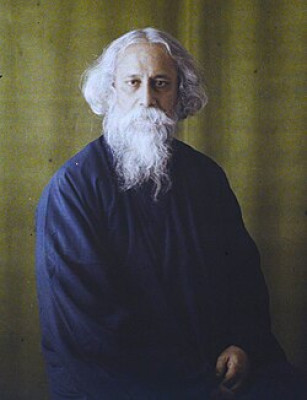
Rabindranath Tagore is remembered as one of the most imaginative and influential figures of modern India. He was not only a poet, but also a novelist, playwright, philosopher, educationist, composer, painter, and social reformer. His life and work shaped the cultural identity of India at the turn of the twentieth century, and his ideas reached far beyond national borders. Born in 1861 in Calcutta, into a family deeply involved in literature, music, and social thought, Tagore grew up in an environment where learning was natural, conversations were rich, and creativity was encouraged. He did not enjoy conventional schooling and preferred to learn on his own through reading, observation, and reflection. This independent spirit would later define both his artistic work and his philosophy of education.
From a young age, Tagore showed a remarkable talent for writing. He began composing poems and stories as a child, and his first collection of verses was published before he turned sixteen. Over the years, his writing matured into a unique voice that blended beauty, spirituality, human emotion, and social awareness. His poetry often explored nature, love, sorrow, inner freedom, and the search for truth, while many of his stories and novels were rooted in everyday life, especially in the lives of women, children, and rural communities. The deep sensitivity in his writing made him beloved not only in India but across the world.
Tagore’s most celebrated work, Gitanjali, is a collection of devotional poems that reflect his spiritual vision and his belief in the presence of the divine within human life and nature. When the English translation of Gitanjali was published, it attracted the attention of writers and thinkers in Europe. In 1913, he became the first non-European to receive the Nobel Prize in Literature, which brought global recognition to his genius. The Nobel Prize did not change his simple lifestyle or his values. Instead, it gave him a wider platform to share his ideas on human dignity, cultural exchange, and harmony between nations.
Although literature was his first love, Tagore’s creative world expanded into many forms. He wrote plays and dance-dramas that were performed in his own school. His music, known as Rabindra Sangeet, includes more than two thousand songs and remains an integral part of Bengali culture. His compositions are lyrical, emotional, and deeply connected to nature. He wrote the national anthem of India, Jana Gana Mana, and his influence is also found in the national anthem of Bangladesh. Tagore began painting later in life and developed a unique visual style that combined imagination, abstraction, and bold lines. Exhibitions of his paintings were held in Europe, where they were praised for their originality.
One of Tagore’s lasting contributions is his work in the field of education. He believed that learning should be joyful, open, and connected to life. In 1901, he founded a school at Santiniketan, away from the noisy city, where children could learn through nature, music, art, and creative thinking. This school later grew into Visva-Bharati University, a center for international culture and learning. Scholars, artists, and students from many countries came to Santiniketan to exchange ideas. Tagore wanted education to build character, curiosity, moral courage, and a spirit of unity among people. His approach was far ahead of his time and continues to inspire educators even today.
Tagore was also deeply concerned about society. He wrote essays and delivered speeches on nationalism, colonialism, equality, and human rights. Although he supported India’s freedom struggle, he rejected narrow nationalism and hatred. He believed that true freedom should come from knowledge, compassion, and cooperation. When the British government committed violence in India, Tagore returned his knighthood in protest, making a strong moral statement. Throughout his life, he remained a voice of conscience, urging people to rise above divisions of caste, religion, race, and nationality.
Travel was another important part of his life. Tagore visited more than thirty countries, including England, America, Japan, China, and many European nations. Everywhere he went, he met artists, writers, scientists, and political leaders. These journeys deepened his belief in cultural dialogue. He saw the world as a family where different traditions could learn from each other. His conversations with figures like Albert Einstein, Romain Rolland, and W.B. Yeats reveal his intellectual depth and wide curiosity. Tagore never allowed pride or fame to limit his thinking. He was humble, humorous, and always ready to learn.
Despite his public achievements, Tagore’s personal life was marked by sorrow. He lost his mother at an early age, and later, his wife, children, and close friends passed away. Yet he transformed grief into creativity. Many of his most beautiful poems and songs were written during times of loss, expressing pain, hope, and the search for inner peace. His writings show a profound understanding of human emotion, and a belief that beauty and truth can be found even in suffering. This emotional honesty is one of the reasons his work continues to touch readers more than a century later.
Tagore’s influence on Indian culture cannot be overstated. He reshaped Bengali literature, introduced new forms of music, encouraged modern art, and helped India discover a fresh sense of identity. His educational experiments shaped generations of students, while his essays and speeches inspired thinkers, reformers, and political leaders. He believed in dignity for all people and worked for rural development, women’s education, and social progress. He was a man of action as well as imagination. He planted trees, built roads, organized workshops, and personally supported villages near Santiniketan. His life was a combination of creativity, service, and spiritual inquiry.
Rabindranath Tagore passed away in 1941, but his legacy remains alive. His poems are recited, his songs are sung, his plays are performed, and his thoughts are discussed in classrooms and homes. His name continues to evoke beauty, wisdom, serenity, and courage. For millions of people in India and around the world, Tagore is not just a historical figure; he is a guiding presence who reminds us to live with grace, freedom, and compassion. His vision of a world united by respect and understanding is still relevant in our time. In literature, education, music, and public life, Tagore’s influence is deep and lasting. He stands as a symbol of human creativity, universal love, and the hope that art can bring people closer to truth and harmony.