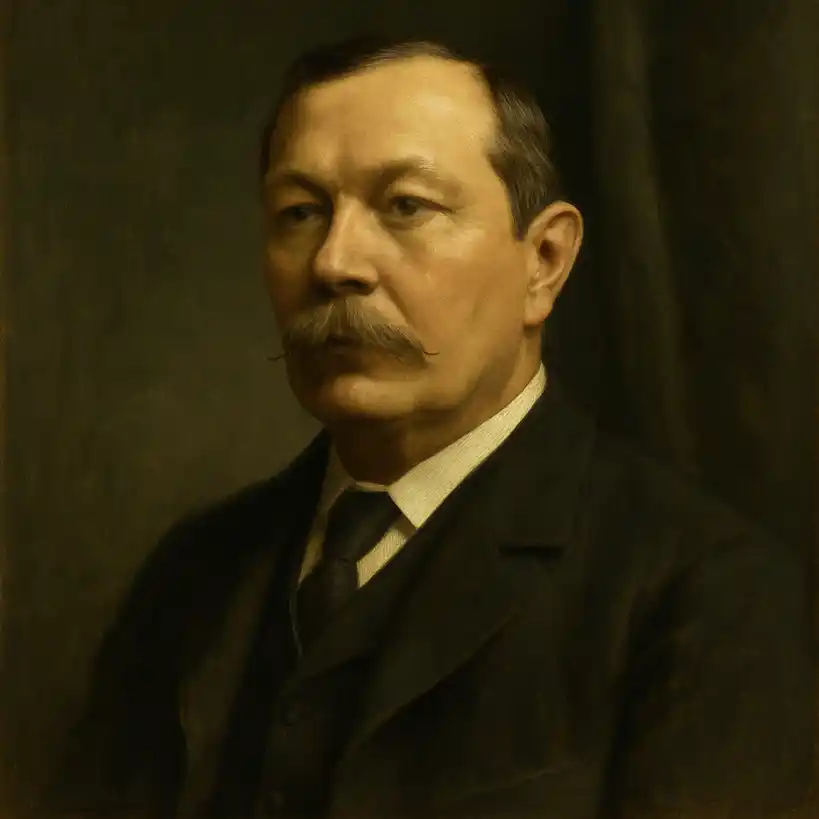
Arthur Conan Doyle is best known as the creator of Sherlock Holmes, one of the most famous fictional detectives in world literature. Yet the life of Conan Doyle was much bigger than the character he made immortal. He was a physician, novelist, short-story writer, historian, traveller, social commentator, spiritual thinker, and an energetic public figure. Born in Edinburgh, Scotland in 1859, Conan Doyle grew up in a family where storytelling, books, and imagination were central. His early interest in adventure and observation later shaped the way he wrote, combining sharp detail with gripping suspense.
Conan Doyle studied medicine at the University of Edinburgh, where he encountered a professor named Dr. Joseph Bell. Bell had a brilliant habit of observing tiny physical clues to understand people’s background, profession, and sometimes their problems. This method became the foundation for the character of Sherlock Holmes. Doyle practised medicine for several years, first on a whaling ship and then as a doctor in Southsea. But patients were few, and he began writing stories in the empty hours between appointments. Slowly, writing became his true calling.
In 1887, Conan Doyle published A Study in Scarlet, the first story introducing Sherlock Holmes and Dr. Watson. It did not make him famous immediately, but it planted a seed. Over the next few years, readers discovered the detective with the sharp mind, violin, pipe, and remarkable logic. The stories captured imaginations everywhere. When The Strand Magazine began publishing Holmes stories regularly, they became an international sensation. People waited every month for the next adventure. Holmes became a household name, and Conan Doyle suddenly found himself a celebrity.
The Holmes stories were clever, fast-moving, and full of surprises. Readers loved the way the detective noticed details no one else saw, and solved mysteries that seemed impossible. However, Conan Doyle himself had mixed feelings. He enjoyed success, but he also feared that Sherlock Holmes was overshadowing his other work. He wanted to write historical novels, adventure stories, and serious books. In frustration, he killed Holmes in the famous story “The Final Problem”, where Holmes and his enemy Moriarty fall over a waterfall. London was shocked. Readers wrote angry letters, newspapers protested, and people wore black bands on their arms. Eventually, Doyle brought Holmes back in The Hound of the Baskervilles and later continued the series. The public simply could not let Holmes die.
Although Sherlock Holmes remains Conan Doyle’s most enduring creation, his work extended far beyond detective fiction. He wrote historical novels like The White Company, science-fiction adventures like The Lost World, plays, poetry, and non-fiction. His writing style was vivid, imaginative, and full of energy. Many of his stories show his love for heroism, exploration, and moral courage. He admired characters who stood against injustice, and he believed that literature could inspire better values in society.
Conan Doyle’s own life was full of action. He served as a doctor during the Boer War in South Africa, and wrote a powerful book defending Britain’s actions, which earned him a knighthood. He campaigned for legal justice in several famous cases, fighting to free men wrongly accused of crimes. He travelled widely, met political leaders, and wrote articles on war, sports, maritime safety, and public policy. Doyle believed that a writer had a duty to speak honestly about important issues. He was generous with his time, often helping people who needed advice or public support.
One of the most unexpected sides of Conan Doyle’s personality was his interest in spiritualism. After the deaths of many family members during the First World War, he became deeply involved in the study of life after death. He believed that communication with spirits was possible, and he wrote books and gave lectures on the subject. Many people agreed with him, while others were skeptical. His friendship with illusionist Harry Houdini became strained because Houdini believed spiritualism was fake. Even if people disagreed, Conan Doyle remained sincere. He sought comfort, meaning, and hope in spiritual ideas. This aspect of his life shows how emotional loss shaped him, just as fame and success did.
Conan Doyle was also a family man. He married twice, first to Louisa Hawkins, who died of illness, and later to Jean Leckie, with whom he had a long and happy relationship. His home life was warm and lively, filled with children, guests, books, and conversation. He enjoyed sports, especially cricket, and he loved the countryside. Although he lived through times of great social change, he kept a strong sense of loyalty, honor, and service.
The success of Sherlock Holmes continued throughout Conan Doyle’s life. Stage plays, illustrations, and later films helped make the detective an international legend. Holmes became a symbol of intelligence, logic, and eccentric charm. Doyle did not realize when he first wrote A Study in Scarlet that he had created a character who would outlive him for centuries. Holmes has been portrayed by hundreds of actors, translated into dozens of languages, and adapted into radio, television, cinema, and digital media. People still quote his lines, discuss his cases, and admire his unmatched reasoning.
Despite his worldwide fame, Conan Doyle remained down-to-earth. He was straightforward, humorous, and friendly. He loved telling stories to family and friends. When visitors asked about Sherlock Holmes, he would sometimes smile and say that Holmes belonged more to the world than to him. For Conan Doyle, writing was not only a profession, but a joy, a responsibility, and a way to explore human nature.
Arthur Conan Doyle passed away in 1930, at the age of seventy-one. He left behind an enormous body of work and a legacy that continues to inspire. His most famous character, Sherlock Holmes, still walks the streets of London in the imagination of millions. But Conan Doyle’s life reminds us that he was more than the creator of a detective. He was a doctor who cared for patients, a soldier who served his country, a thinker who defended the innocent, a traveler who sought adventure, and a writer who believed in the power of stories. His voice lives on in his books—full of mystery, energy, and moral strength. The world he created continues to entertain and enlighten readers, proving that imagination, when guided by curiosity and courage, can shape culture for generations.